OPC-UA Source
The Tributech OPC-UA Source allows to connect to an OPC Unified Architecture (UA) server and receive data. The Tributech OPC-UA Source acts like a OPC-UA Client in a docker environment and enables the forwarding of the data to a Tributech Agent stream.
Setup
The Tributech OPC-UA Source image can be started without any dependencies but will not be functional without a valid Twin Configuration or MessageBroker connect to the Tributech Agent. The TwinConfiguration can be provided via the Tributech Node (recommended) or MessageBroker (see Source Integration). The OPC-UA Source will automatically connect to the Tributech Agent if the Tributech Agent is running and correct MessageBroker settings are set. In the following part we will describe the setup of a Tributech OPC-UA Source:
- Create a
docker-compose.ymlfile with the following content (adjustments required):
version: '3.6'

services:
  # Prepares the bind-mounted folders for the Tributech Agent, which runs as the
  # non-root user 1654 and ships without the tooling to change ownership itself.
  # This replaces a manual `sudo chown -R 1654:1654 enrollment volumes` on the host.
  init-permissions:
    image: busybox:1.36
    user: "0:0"
    command: sh -c "chown -R 1654:1654 /mnt/enrollment /mnt/volumes"
    volumes:
      - ./enrollment:/mnt/enrollment
      - ./volumes:/mnt/volumes

  source-opcua:
    restart: unless-stopped
    image: ${DOCKER_REGISTRY-tributech.azurecr.io/}tributech-source-opcua:${SOURCE_TAG:-5.4.0}
    depends_on:
      - mosquitto-server
      - tributech-agent
    environment:
      - MqttOptions__MQTTHost=mosquitto-server
      - Logging__LogLevel__Default=Information
      - Logging__LogLevel__ADSRouter=Error
    networks:
      - opcua-net
    logging:
      driver: "json-file"
      options:
        max-size: "2m"
        max-file: "5"

  tributech-agent:
    image: ${DOCKER_REGISTRY-tributech.azurecr.io/}tributech-agent:${AGENT_TAG:-5.6.0}
    depends_on:
      mosquitto-server:
        condition: service_started
      init-permissions:
        condition: service_completed_successfully
    environment:
      - Logging__LogLevel__Default=Information
      - MqttOptions__MQTTHost=mosquitto-server
      - EdgeDeviceOptions__NodeUrl=${NODE_URL:?"The Tributech Node Url is required"}
    networks:
      - opcua-net
    ports:
      - "5001:8080" # enable access to agent REST-API (e.g. for configuration with Agent-Companion)
    volumes:
      - ./volumes:/app/data # volume mapping for permanent storage of keys and datatwin file
      - ./enrollment:/app/enrollment # local enrollment folder mounted to /app/enrollment
    restart: unless-stopped
    logging:
      driver: "json-file"
      options:
        max-size: "2m"
        max-file: "5"

  mosquitto-server:
    image: eclipse-mosquitto:${MQTT_TAG:-1.6}
    restart: unless-stopped
    networks:
      - opcua-net

networks:
  opcua-net:
The enrollment and volumes folders must be accessible to the unprivileged user the Agent runs as, see
Container File Permissions.
Adjust the setting for the Tributech Agent to your environment, sample value:
tributech-agent:
    ...
    environment:
      ...
      - EdgeDeviceOptions__NodeUrl=https://my-environment.tributech-node.com
The Tributech Agent authenticates with the Tributech Node using enrollment certificates provided through a local enrollment folder mounted into the container (the ./enrollment:/app/enrollment volume in the docker-compose.yml above). See Authentication Certificates (Enrollment) and Docker volumes in the Setup guide for how to create and provide it. If no Agent ID is configured, the agent generates a random one on first start.
Configuration
After setting up the Tributech OPC-UA Source we need to activate it in the Tributech Node (see Agent Management) and configure the TwinConfiguration.
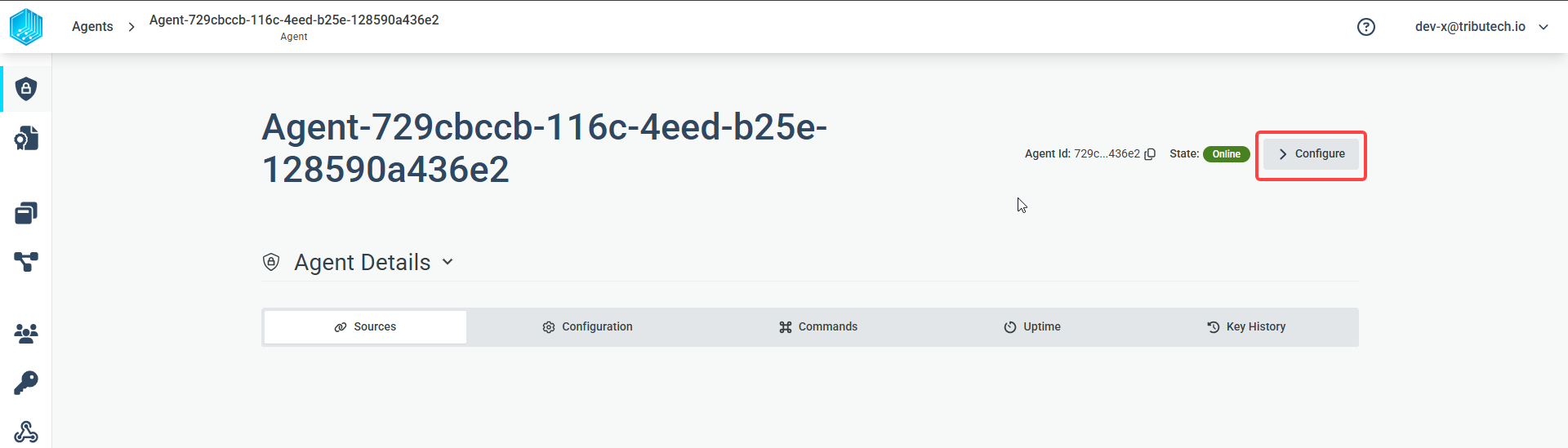
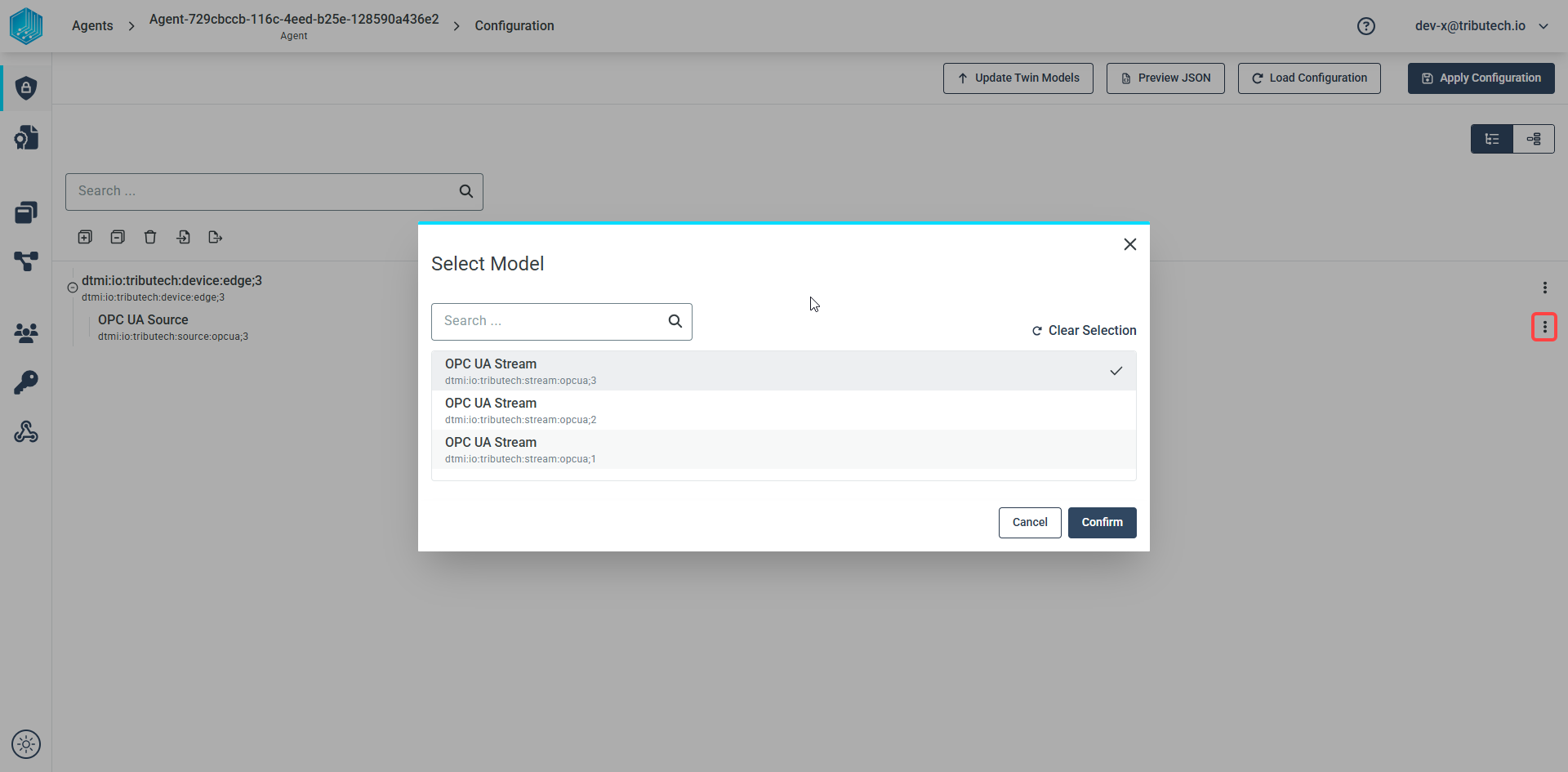
We can then add a new OPC-UA Stream with the three dots menu on the right side of the OPC-UA Source entry:
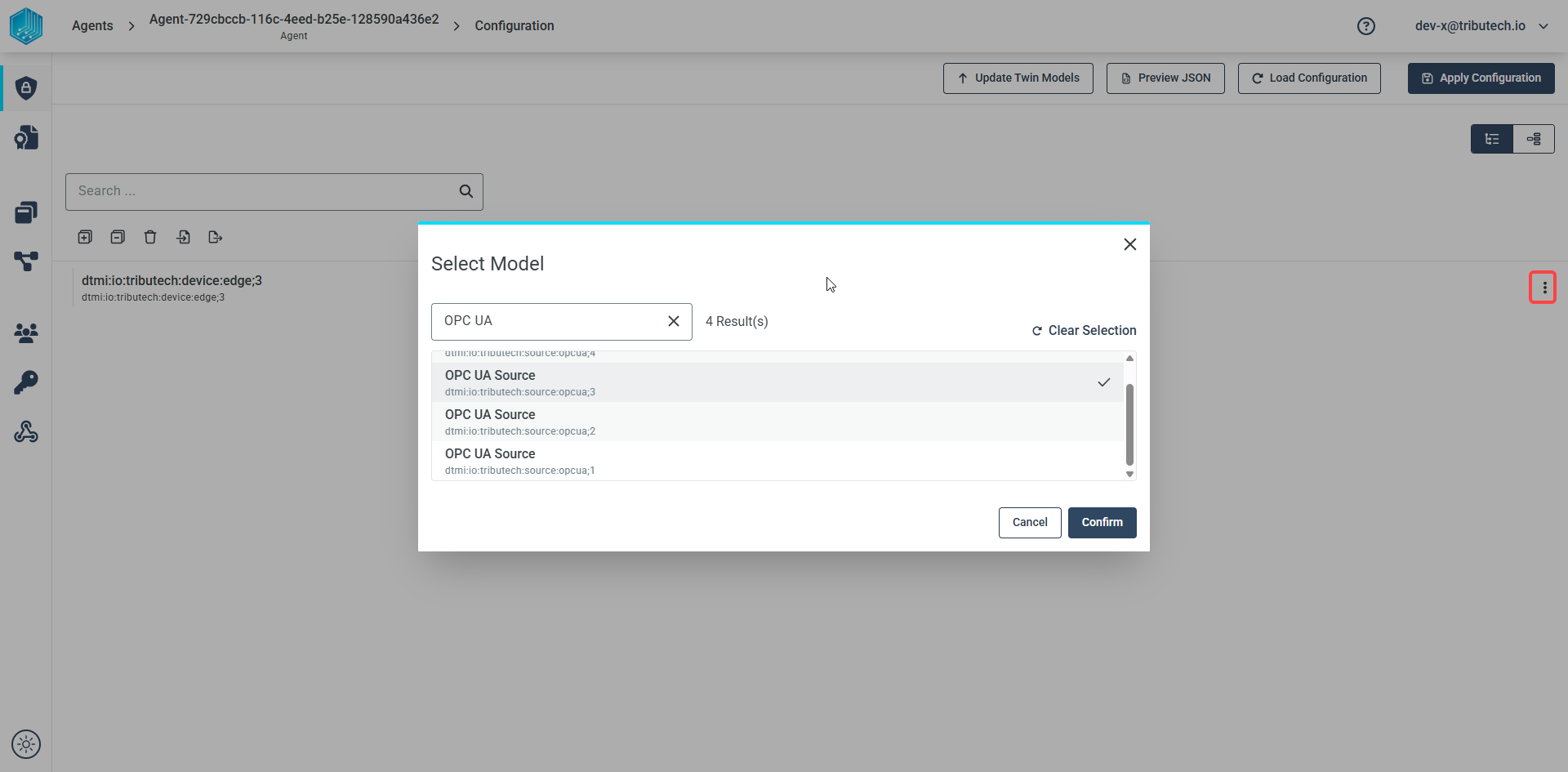
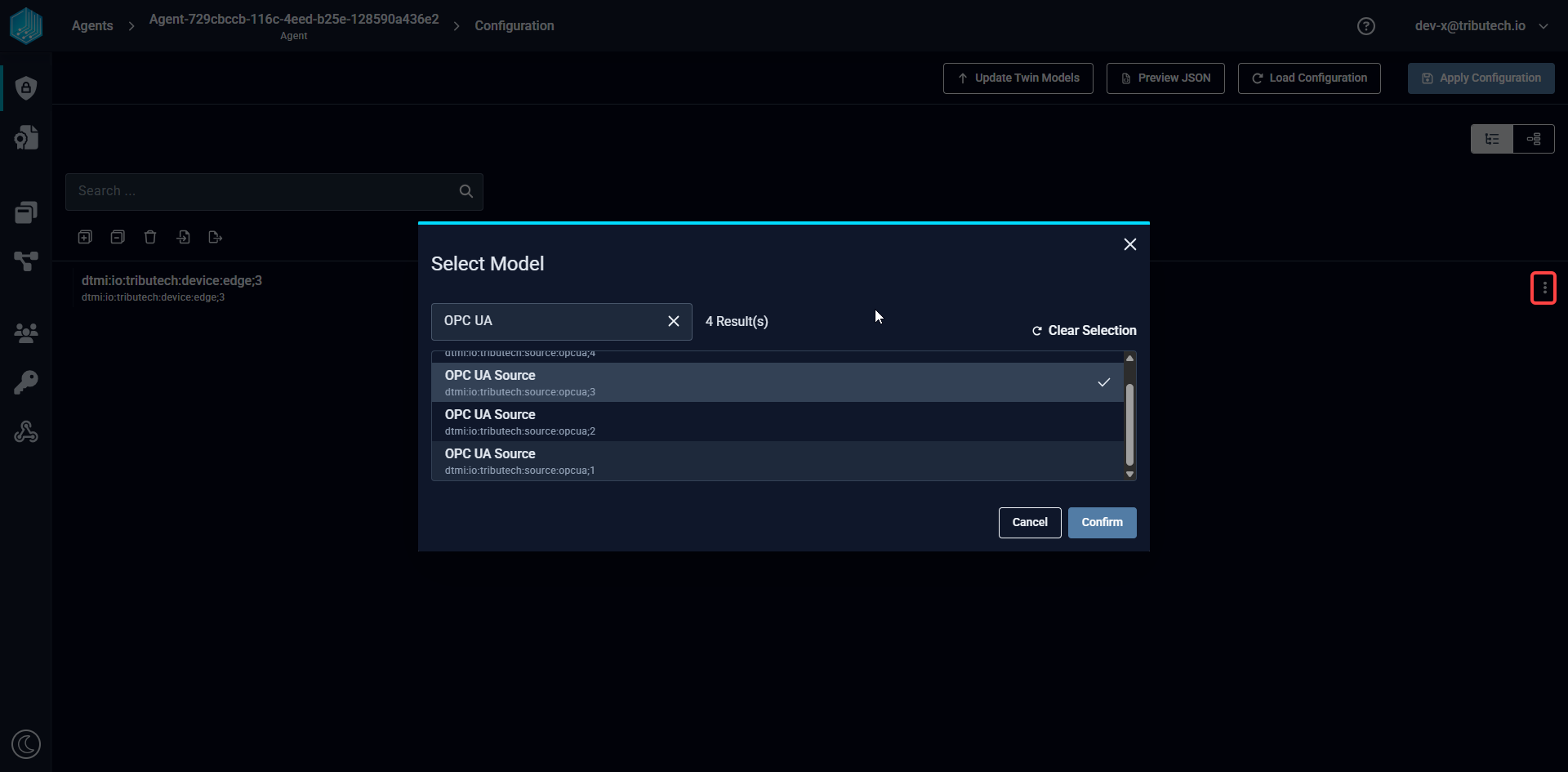
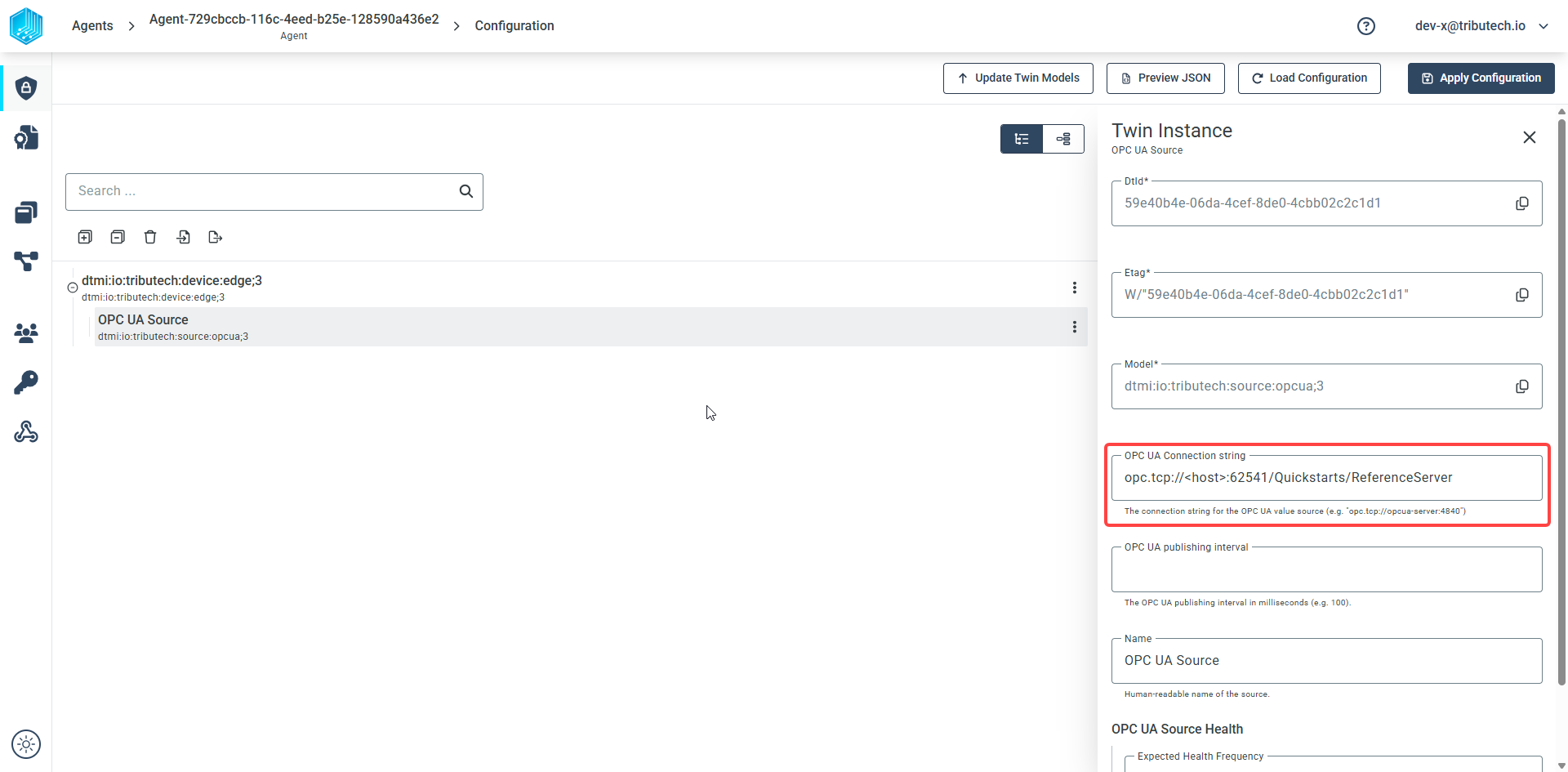
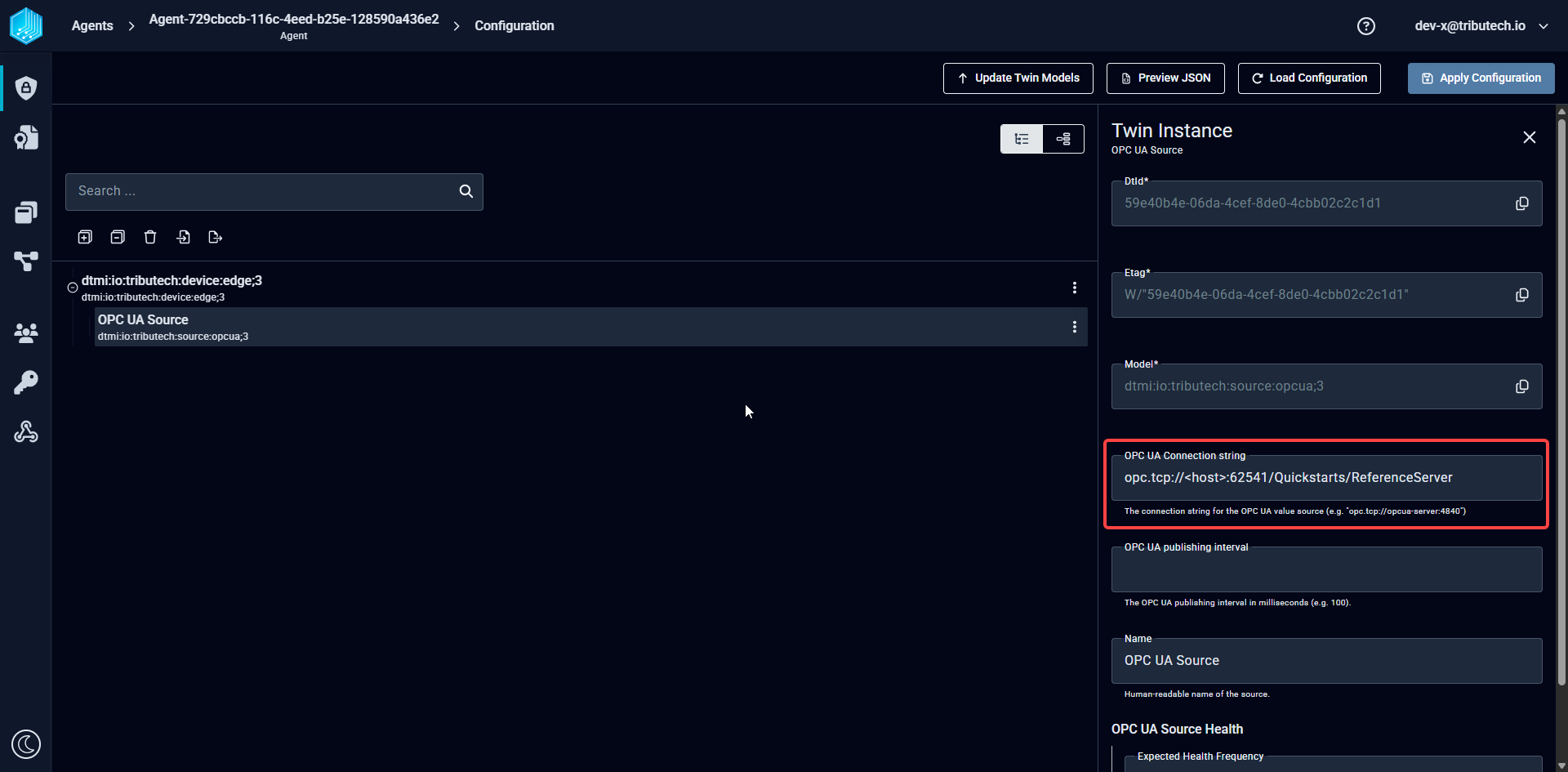
In order to connect to the OPC-UA Server we need to configure the OPC-UA Server settings. The following screenshot shows the description for each setting (an example server endpoint is opc.tcp://<host>:62541/Quickstarts/ReferenceServer):
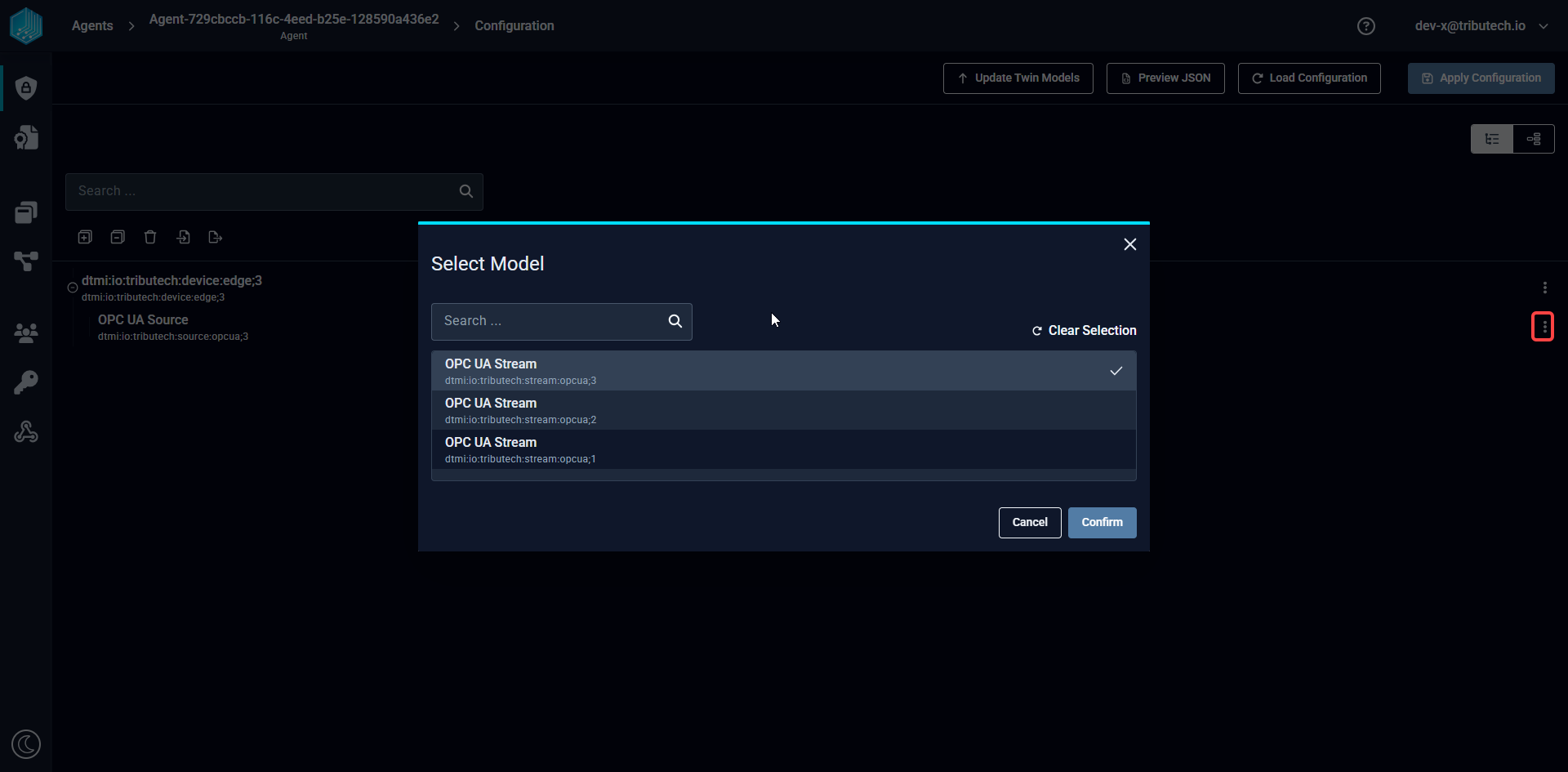
Next we can add a new OPC-UA Stream by clicking on the Add Streams and OPC UA Stream:
The OPC-UA Stream can be configured with the following settings (the Identifier shown is an example):
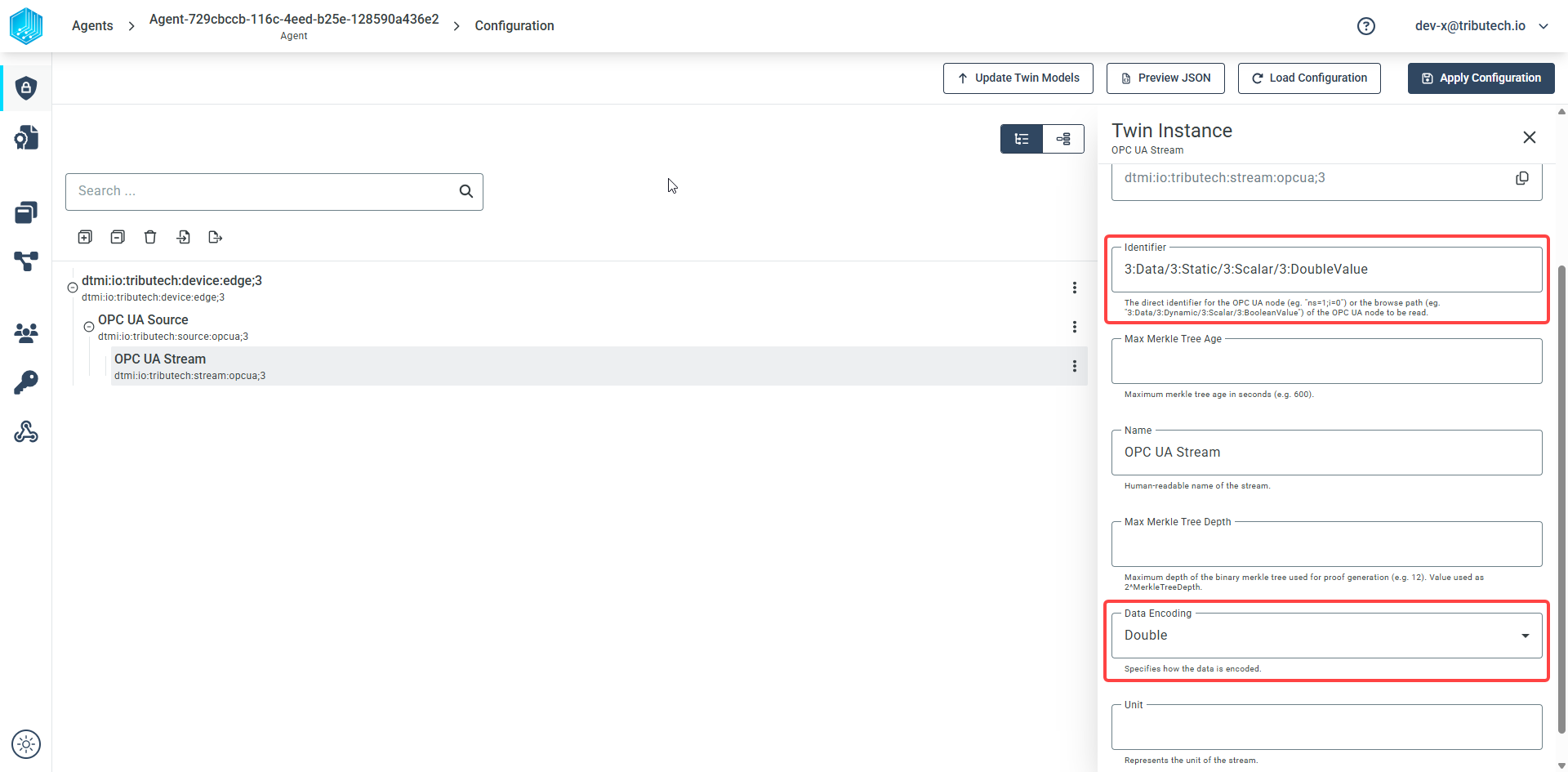
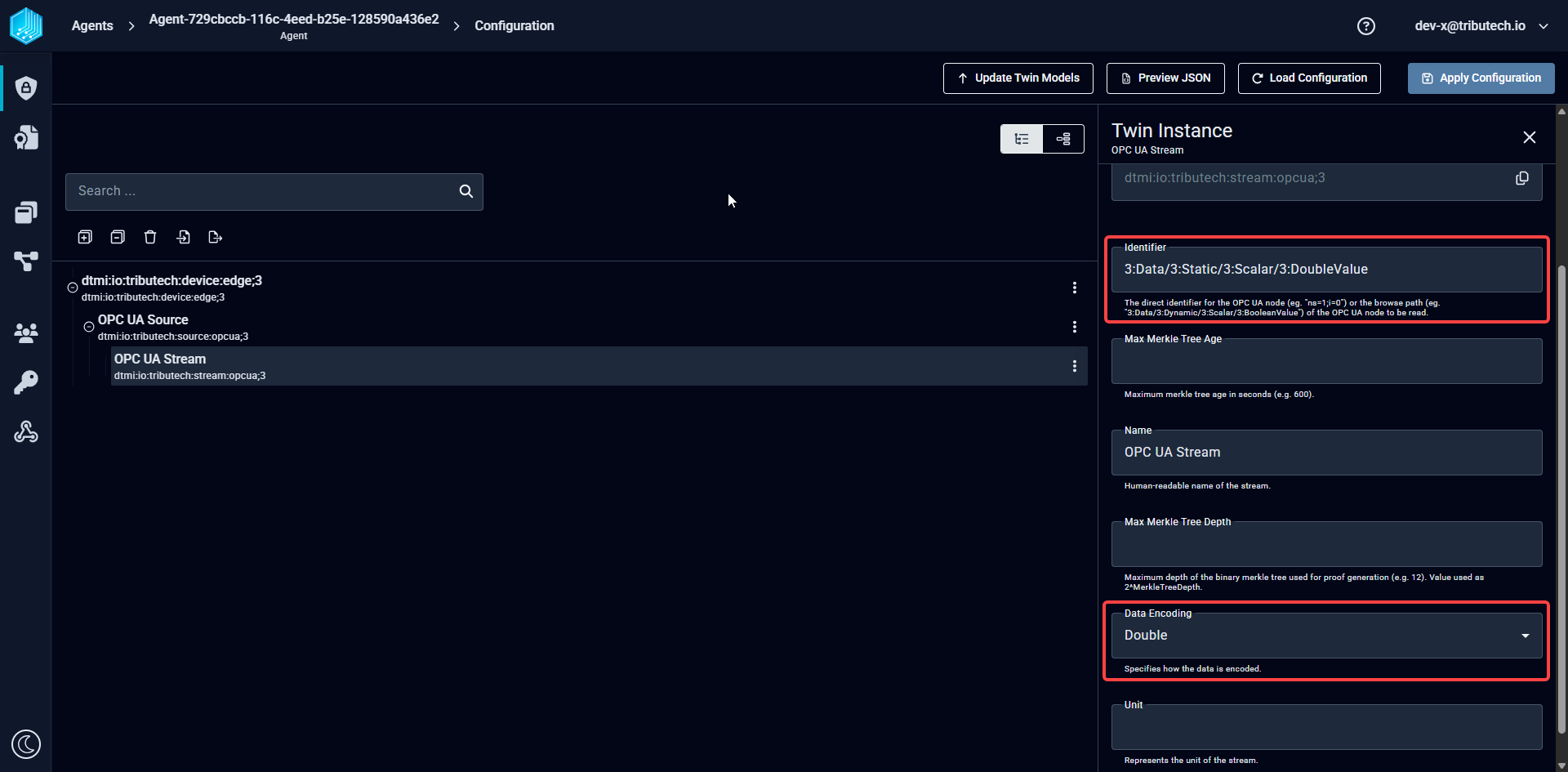
We can continue adding every Identifier we want to read from the OPC-UA Server.
Each OPC-UA Stream is bound to a node on the server via its Identifier, which can be given in two forms:
- Node ID — the server's node identifier, e.g.
ns=3;i=1837(nsis the namespace index,ithe numeric identifier). - Relative (browse) path — a path of
namespaceIndex:BrowseNamesegments separated by/, e.g.3:Data/3:Static/3:Scalar/3:DoubleValue. The source resolves the path by browsing the server's address space.
Node IDs continue to work as before. Relative paths are often more convenient when the same configuration is deployed to multiple servers or devices, where the numeric node IDs and namespace indices can differ from server to server while the browse path stays the same. If an Identifier cannot be resolved on the server, the corresponding stream is marked as faulty and reported in the source's Health Check.
After all streams have been configured, we can apply the configuration to the Tributech Agent by clicking on the APPLY CONFIGURATION button in the top right corner.
Without a running OPC-UA Server we will not receive any data on the Tributech Node.
Value Change Options
The basic handling of Value Change Options (VCO) can be found in Source Integration. This section contains the concrete handling of the Step (Delta) for the simulated source. The following list contains the description for each supported Stream Data Encoding where X represents the value for Step (Delta):
- Double, Int32, Long, Float: defines the minimum difference between values to be submitted, the change is always compared to the last successful submitted value, e.g. if X= 3 if the double values 1, 2, 5, 8, 10, 11, 14 are received by the Tributech Source only 1, 5, 8, 11, 14 will be submitted.
- Byte Array: will only be submitted if the current and last submitted value are not equal
- String UTF 8: will only be submitted if the current and last submitted value are not equal
- Boolean: will only be submitted if the current and last submitted value are not equal
Authentication and Security
How the OPC-UA Source connects to the server is controlled by two independent options, set as environment variables on the opcua-source service. What the server actually accepts depends on the OPC-UA server's own configuration.
OPCUASourceOptions__UseSecurity— whentrue, the communication channel to the server is encrypted (message signing/encryption); whenfalsethe channel is unencrypted.OPCUASourceOptions__AuthMode— how the source authenticates as a user:Anonymous(default) — no user identity.UsernamePassword— user-level access control with a username and password (OPCUASourceOptions__Username/OPCUASourceOptions__Password).Certificate— user identity via an X.509 client certificate (OPCUASourceOptions__UserCertificatePath).
The two options can be combined:
| AuthMode | UseSecurity | Result |
|---|---|---|
Anonymous | false | Unencrypted channel, no user identity |
Anonymous | true | Encrypted channel, no user identity |
UsernamePassword | false | Unencrypted channel, user-level access control |
UsernamePassword | true | Encrypted channel and user-level access control (recommended) |
Certificate | (always secured) | Encrypted channel + user identity via certificate |
For example, to authenticate with a username and password over an encrypted channel, add the following to the opcua-source service environment:
    environment:
      # ...
      - OPCUASourceOptions__UseSecurity=true
      - OPCUASourceOptions__AuthMode=UsernamePassword
      - OPCUASourceOptions__Username=user1
      - OPCUASourceOptions__Password=password
To establish a secured channel the source uses an OPC-UA application certificate. By default an RSA application certificate is generated automatically on first start; a custom one can be supplied via OPCUASourceOptions__AppCertificatePath. When using Certificate auth mode, the application and user certificate key types (RSA/ECC) must be compatible with the security policies the server exposes.